Showing posts with label naval. Show all posts

Tuesday, July 8, 2025

Naval Playtest 4 - Nearly There!

With some amendments and clarifications now applied to my 17th century naval rules, the Rejects took to the "online" seas again to try them out and provide much wanted feedback.

The players commanded the ships as follows:

Lee - La Therese 3rd rate, 8 dice
Jonathan - Le Lion Rouge 4th rate, 7+1 dice (extra for master gunner)
Plus, a yacht the St Ann: unrated, 2 dice

Steve - L'Hercule 4th rate, 7 dice
Dan - L'Etoile de Diane 5th rate, 6 dice
Ray - L'Elbeuf 6th rate, 5 dice

My particular focus was on the changes I'd made to shooting and a slight amendment to the movement sequence.

On with the game.

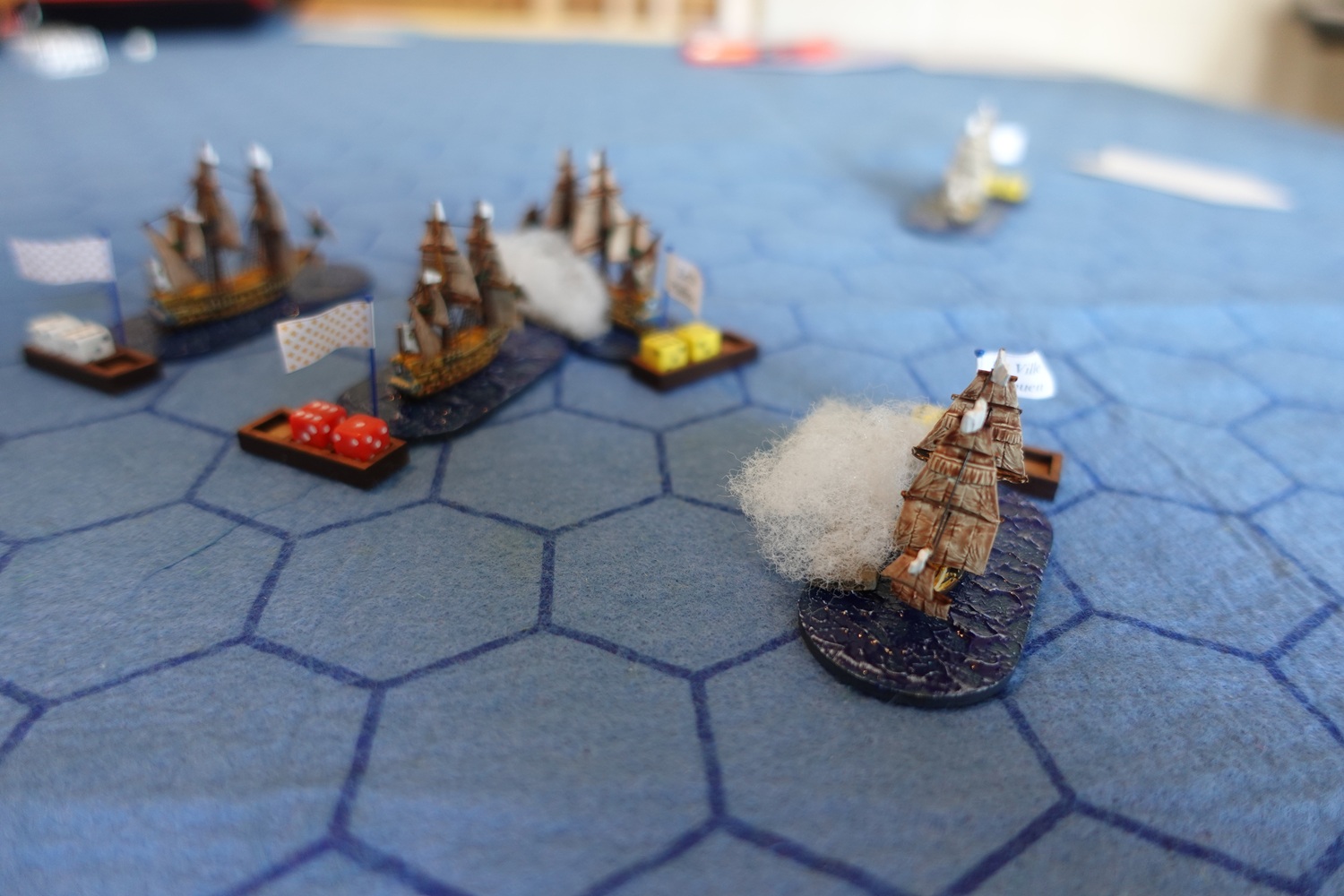
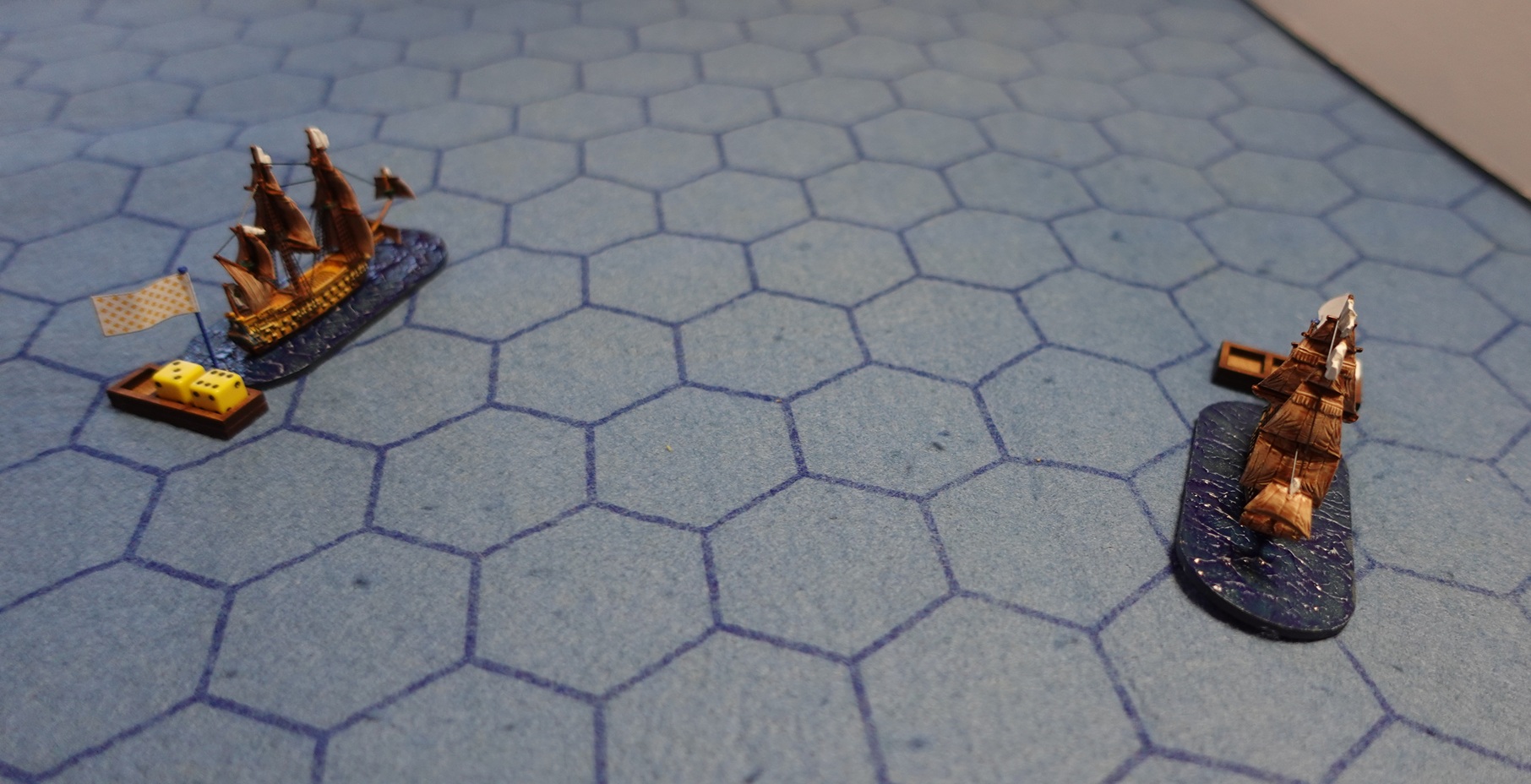
The two sides had to negotiate the islands to get at each other.  For the purpose of orientation, the dice are always placed at the stern of the ships.  So, direction of travel should be clear... I hope.

L'Etoile de Diane and L'Elbeuf.

The opposing squadron.

Dan, Ray and Steve benefitted from the wind and moved quickly.  Having to sail into the wind meant a slower start for Jonathan and Lee.

One change to the turn sequence was that instead of moving a squadron at a time, I wanted to trial the squadron most windward moving one ship first, then alternate ship movement thereafter.  Of course, the option to attempt an interruption and steal a move was still available.

My reasoning was that in games with one squadron a side this stopped complete control by one side.  Plus, in multi-squadron games the side with the weather gauge moves a squadron first then alternate squadrons thereafter.

L'Hercule decided to take a lone route towards the enemy and found himself subject to a thumping broadside from Le Lion Rouge.

With Ray and Dan rounding the island to the north, Steve found himself isolated against a whole squadron.  Especially as Lee, commanding La Therese, was about to unleash something nasty.

Despite having taken some earlier damage from L'Elbeuf, La Therese sailed neatly into position to bow rake L'Hercule.

Another slight amendment was to make it just a little trickier to acquire a raking shot.  To achieve this a ship cannot rake if they conduct a turn in the hex from which they are going to shoot.  In other words, the raking ship must sail straight into position.  My reasoning being that it requires skill and timing to deliver the shot.  Thus, hasty last minute turns are not in keeping.

I missed taking a few photos I'm afraid.
L'Hercule, being severely damage is limping away.  St Ann's rudder is shot and is unable to steer.  Dan, commanding L'Etoile de Diane, chased after St Ann but found himself the victim of some clever manoeuvring by Le Lion Rouge.  Captain Jon then delivered a game winning stern rake.

The stern rake delivered by Le Lion Rouge.

Jonathan and Lee were victorious as the opposing squadron reached its breakpoint and scattered in the hope of an escape.

Afterthoughts
With all players being a little more familiar with the rules, the game lasted c.80 minutes.  I thought it was fun and played smoothly.

I was pleased that the raking fire amendment to both position and differentiating between bow and stern rakes played out so well.

The order of ship movement worked fine and the players seemed pleased.  However, there was a discussion about this and how it might be tweaked further.  Some interesting ideas were mooted and taken note of.

There was also a good discussion about what happens to a ship once it reaches zero dice.  The current situation demands that the afflicted ship either tries to make an escape or, if carrying a critical damage, sinks.  It didn't really have the right feel in a period when capturing ships was such a n important feature.  So, there were plenty of excellent ideas and solutions.  I now have plenty to ponder.  The key thing is to make the changes as small as possible and keep the principle of the game design - fast, fun, and not burdened with small detail and things to keep track of.

On the whole, I am pleased that we have rules which give a fun and, I believe, challenging game.

My thanks to the Rejects.  Jonathan must be included as a Reject, being a founding member of the Spokane Chapter.  Your feedback and good ideas have been invaluable.


Tuesday, July 1, 2025

Naval Playtest 3

With two play tests under the belt, I decided to extend a wider invitation for a third test game.  Hopefully for a bit of fun but also to garner some constructive criticism.  Of particular interest to me would be any comments about changes I had made to turning.

With five players, I decided to have two versus three.  So, Dan and Lee had the heavier gunned ships against Steve, Jon and Ray who commanded lighter more nimble vessels.

Dan - Le St Phillipe 2nd rate:  9 Ship Dice; Top Speed 5
Lee - La Therese 2nd rate: 9 dice; top speed 5

Steve - L'Hercule 4th rate: 7 dice; top speed 7
Jon - Le Lion Rouge 4th rate: 7 dice; top speed 7
Ray - La Ville de Rouen 5th rate: 6 dice; top speed 7

Top speed being defined as the movement when the ship is broad reaching.

The battles
We managed to get in two games.  So, here is the first.

The background for this game being that the heavier ships of Dan's and Lee's are being chased by the lighter ships.  With the pack now overtaking them the slower but more powerful ships are resigned to having to engage.

By the way, the dice are always placed at the ships' stern.  Hopefully, that will help you see their direction of travel.

The two squadrons sailing in parallel.  

The lighter squadron led by L'Hercule.

The larger ships led by Le St Philippe.

The wind was not kind to Dan and Lee, who found themselves having to turn away from the enemy to avoid trying to run into the wind.

The lighter squadron were able keep the wind in their sails and their sights on their prey.

Taking advantage of the weather gauge, L'Hercule hove into a position to deliver the first broadside on Le St Philippe.

Le Lion Rouge, captained by Jonathan, sailed within range for a broadside at long range.

With the St Philippe badly mauled, it sought some protection by trying to put distance between it and the enemy.  However, it would not be able to avoid their attentions and would soon have to strike their colours.  Victory to the lighter and more nimble craft.

To determine a victor, each squadron has a number of hits it can sustain before making a break for it.  I set this at 50% of the total squadron dice.  So, Dan and Lee would break at 9 hits.  The others would break at 10 hits.  The break point can be tweaked, for example an experienced or well led squadron might have a 60% break point or a poorly led or mutinous squadron at 40% of the dice.

In this first game Dan and Lee took 9 hits, the light squadron took none: 9-0

Game 2

The squadrons were again running parallel but now in opposite directions.  Plus, a couple of islands to perhaps complicate things.

This time the wind favoured the larger ships of Dan and Lee.  Meanwhile, Jonathan, Ray and Steve turned away from the enemy in order to benefit from the wind.

As La Therese and Le St Philippe rounded the island, things were looking good.  However, the enemy maintained a good position.

As La Ville de Rouen lined up its broadside, La Therese let loose its own causing significant damage to Rays command.  However, Captain Jonathan moved in support and bloodied La Therese.

Even though it was the move of La Ville de Rouen, the rules allow an attempt to interrupt its shooting.  This does cost the allocation of some precious dice.  Lee in La Therese succeeded in his interruption and got his fire in first.

At this point the wind changed direction.  Ray, worried about the damage his ship had sustained and sailed away to try and affect some repairs.  However, Jonathan and Steve appear to be trying the cut off the forward and rear of the heavy squadron.

L'Hercule moved into a raking position.  With nowhere to go and in a desperate position, Lee orders his crew to board L'Hercule.

After a protracted struggle, Steve leads his crew to victory and captures La Therese as a prize.
As their colours are struck down, Dan of Le St Phillipe recognises that the tide has turned against him and makes good an escape amongst the islands as cover.

This second game was much closer.  All players had quickly understood the rules and the impact of the weather gauge and the use of interruptions.  Whilst victory went to the lighter and more nimble squadron again, it should be noted that the break points were closer 9-7.

Afterthoughts
I thoroughly enjoyed the two games.  The players will have to pass their own judgement but seemed happy.

The rules played how I wanted them to: fast, fun and without complication.  In fact, each game was completed in just under an hour.

I was happy about the changes I had made to the turning arcs of the ships... pat on the back!

Happily, a couple of tweaks and clarifications did come out of the "post-match" analysis.  First, a sensible refinement to raking shots. Second, that separate broadsides can be made (to port and starboard) in different turns without the need to reload after just one broadside.

We also had a discussion about the order in which the squadrons moved.  The most windward moves first.  The debate was about whether moving first could be a penalty.  It was a good discussion.  For the moment, I am going to leave it as it is and review after some more games.

All in all, I had an enjoyable and, from a rules writing perspective, profitable evening.  Thank you to all who participated.


Sunday, June 22, 2025

Naval Playtest 2

What should you do on one of the hottest days of the year.  Well, Steve and I stayed cool and met online to do a second playtest of my naval rules for my 17th Century ships that might otherwise rest unloved in a box in my cellar. 


Today's outing was really about testing the rules with more than one ship per side.  

The basic idea of the rules is to assume a lot of things happen of their own accord and just deal with the action and excitement.  For those who like to do tests for running up the main sail or shoot differing types of ammo, this is not for you.  The intention is quick and fun.

The mechanic that runs throughout is that a six on a d6 does something.  Each rating of ship starts with a set number of d6, for example a First Rate carrying 100 guns would start with 10 d6, a Fourth Rate with 56 guns might have 7 d6.  These dice are used during a turn to shoot, reload, repair and to interrupt another player's move.  There are only two modifiers, both on shooting, one for close range and one for raking.  

The ship that's been activated can perform its actions in any order.  Everything except moving requires a six to perform it.  The number of d6 rolled to get the six is decided on by the player.  So, if the Fourth Rater spends 4 dice reloading, it only has 3 dice left for shooting... if the reloading dice successfully produced a six!

A ship degrades during a battle.  Each hit is the loss of one of the ship's d6.  In a way, the rules takes a resource management approach.  The player has to allocate dice to different jobs.  However, as the number of dice (resources) reduces due to hits, the management of the resources become more critical. Thus, more decision points for the player.

That's enough blah, blah!


So, with three ships each we set about it.

With the wind rolled for, Steve was going to enjoy the early advantage of being windward.

Steve made sure that he kept the wind. Meanwhile, I was forced to tack into it.


Very quickly, Steve was positioning his ships to profit from the elements.

And so Steve manoeuvred nicely to bring raking fire. 
His ship, Le Saint Phillipe had 8 dice.  All of which he brought to bear.  Being close range and raking, that gave him a +2 on the dice.  Effectively now needing 4-6 to hit.  Which he rolled with devastating effect.  A consequence was the need to roll for critical damage. In this case my vessel was holed beneath the waterline and likely to sink if not repaired.

The raking shot that devastated my ship of the line.

Not content, Steve then brought a broadside against the same ship.

Steve would now board. With the crew decimated, it was easily captured.

Steve then used the weather gauge to sail into position to rake a second of my squadron.

However, with my 2 remaining ships, I gave a broadside and cut their line.

I will freely admit that I my knowledge of naval conflict in the age of sail is extremely limited.  However, I recall something from somewhere that gunnery fire from these ships required execution at the optimal point as the ship rolled.  I think that was to ensure the shot didn't end up being fired into the sea and killing sharks!  So, in a situation above with a double broadside the allocated dice are equally divided.  This is to abstract that the gunnery may not be at it's best on either side due to having to fire despite the roll of the vessel.  Nonetheless, even with reduced dice, was I still rolling with a 50% chance of doing damage.

But, this would be too little and too late.  


Steve lets rip with his cannons.

With that blow, my squadron has had enough and decides to try and put as much ocean between them the Steve's ships as possible.

I tested a morale/exhaustion threshold for the squadrons.  Essentially, a squadron would decide to withdraw once it had suffered hits equal to 50% of the starting total of ship dice.  My three ships started with a total of 21 dice.  So, I set the threshold at suffering 11 hits before withdrawing... which I did.

The final positions at the point my squadron decided that it need to get away.

Afterthoughts.
That was a lot of fun.  To reiterate a phrase from the first playtest, it was "fast and furious".  Exactly what I want.

  • Whilst it played quickly, there were a lot of decision points throughout the game.  As the game allows for interrupts, the non-phasing player really needs to pay attention and is therefore fully involved.
  • The game worked well with multiple ships per side.  One on one gave a good game.  Three on three was equally entertaining.
  • We had a good discussion and quickly ironed out some creases with the boarding and recrewing rules.
  • The "resource management" of the dice made the game zip along nicely.  Plus, we did not get bogged down in what mast was hit or how many guns out of action etc.  The abstraction with the number of dice meant that we could concentrate on sailing and action.
  • There were critical hits during the game.  This occurs when shooting produces more than 50% hits on a ship.  This did not happen often, but was fun when it did.
  • Steve and I had a good chat about turning.  Whilst the game worked, we both felt that a little tweak to calm some turns was required.  This I have now looked at and await an opportunity to test the changes out.
  • I am, so far, pleased that the tweaks mentioned above keep to my design principles and maintain the simplicity of the rules.
  • Lastly, the exhaustion/morale threshold produced a good end to the game and a decision on a winner.  Plus, the state of my squadron at the point that it was reached felt like the moment an admiral might want to extricate himself.
All in all, the game felt right and seemed plausible in its outcome.  I finish here feeling quite pleased.


Thursday, June 5, 2025

A Naval Encounter - Rejects as Guinea Pigs

Having painted a French squadron for the Anglo-Dutch wars it doesn't look like the Rejects are getting anywhere close to playing with these toys...

So, I decided to ignore the rules we'd planned to use (Mad for War by Barry Hilton) and quickly scribbled an easy fast play set to try out with the Rejects remotely during our usual online paint and chat evening.

The rules avoid a lot of detail for simplicity of play via Zoom.  I expected them to be rubbish and openly shared with the players, Dan and Steve, that they were guinea pigs for the night.  I sent them a copy of the rules as they currently stood... untidy and barely legible.

The rules as originally written. The work of c.20 to 30 minutes... and it shows!  Once they have been tested and refined I may type them and share them.

Each player started by taking command of one ship apiece, both classed as 2nd Rate ships of the line.

Their starting positions.

They were quickly at each other.  However Steve, commanding Le Saint Philippe, got into a position at close range and able to deliver raking fire.  It was devastating.

Dan, captaining La Therese, desperately tried to keep distance to try and make some repairs.

However, Le Saint Philippe was never far away and continued to harass Captain Dan.

Until eventually, Steve manoeuvred onto the rear of La Therese (!) and delivered the coup de grace with another raking shot.

That was the game over in just under an hour with poor Dan never able to recover from the first raking broadside.  We had a little chat about the rules and set about a second game.

This time, some islands were placed as terrain with the opponents placed behind each.

Perhaps having learnt the rules, the two commanders were slightly cagier in the manoeuvres.

Regardless, Steve managed to get into a position for another raking shot. However, his devastating dice from game one were now starting to obey the laws of probability.  La Therese got off lightly.

The cat and mouse sailing of both continue as each sought position.  Both having to contend with the wind and islands.  Steve was a little abler in handling running repairs compared to Dan.

Each sought to gain wind advantage.

Eventually closing...

...to deliver broadsides at close range.

The battle had to end there.  Steve and Le Saint Philippe were able to claim a victory by virtue of having inflicted more damage on La Therese.


After Thoughts
The aim of the rules was to abstract a lot and keep things really simple.  Each rate of ship starts with a number of dice with which everything has to be done.  So the principle is that commanders have to make decisions about their priorities for the turn.  With hits, these dice are reduced.  The reducing dice makes the decision making both challenging and critical.  Pleasingly, this seemed to be how things played out.

With the players' help, some, but not many, rules were tweaked.  The general opinion being that the rules played very well and were "fast and fun" (Dan's words).  This was exactly what I was aiming for.  We all agreed that the next test would be try them out with multiple ships per side.

My other aim for the evening was to test the remote gaming set up.  With no dedicated space anymore, I have to use the dining room table.  My concern was principally lighting the gaming area.  Happily, Dan and Steve said that my arrangement (two cameras and a special lamp borrowed from my son) worked well.  Whilst I won't be able to keep games set up over a number of evenings, it does look like single evening games are a possibility again.

It was a fun evening with turns that whizzed by.  Thanks to my guinea pigs Dan and Steve and their feedback.  I'm looking forward to the next encounter.


Most Popular Posts