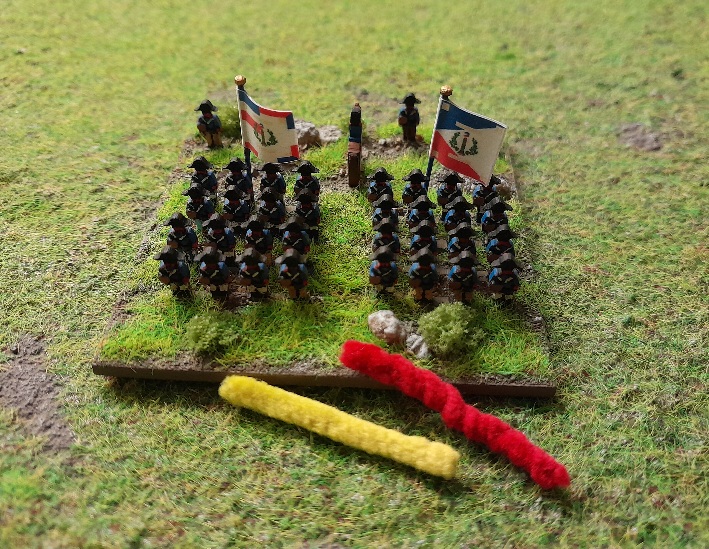
... and the shape is a hex!
Being a little behind the curve on hosting remote games, I am now trying to find ways to improve my umpiring output. Having had the honour to participate in a remote game hosted by Jonathan of Palouse Wargaming Journal, I experienced what a well organised and executed remote game looks like.
The experience of using a hex or grid format for moving and firing seems, on reflection, to make player order giving much easier and clearer, removes the potential for error and even possible player/umpire tension. I also wanted to use a set of rules that I already use in face to face battles. That way the mechanisms remain familiar to the participants.
So, the other evening I put on a test game with some Rejects with an Austrian War of Succession scenario. I adapted Koenig Krieg rules to hex movement and ranges, and played it with only one other adaptation. I was aware of the possibility of a fast unit moving through the hexes to the front and adjacent of an enemy without the enemy evening getting the chance to react. So, I put in a zone of control to prohibit this type of move.
An Austrian infantry brigade hold the hill in the centre. Whilst to the left, the French (2 infantry and 2 cavalry brigades) are tasked to oust them. Meanwhile, two Austrian cavalry brigades are rushing to support from the right.

The first, and main, problem I encountered was the reflected glare off the table. The table is just painted and then marked in dots for the hexes. The paint seems to have a satin sheen to it.
The glare is more marked in this picture.
 |
| The view from the hill towards the approaching French. |
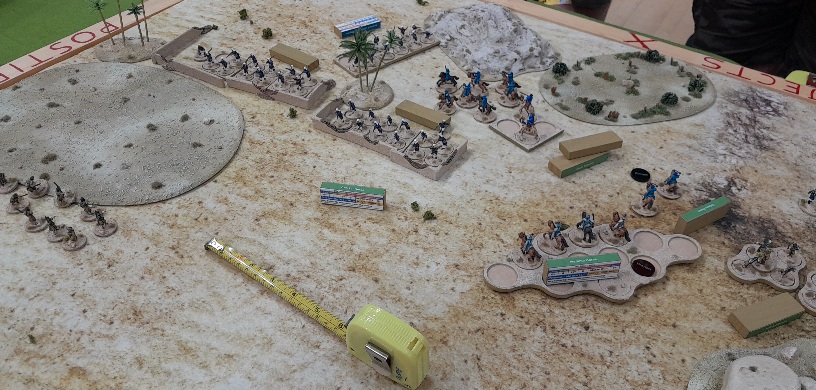
I was trying to juggle two cameras and find positions that gave a clear view. So, I didn't take photographs. But here are a couple of pictures of the situation at the end of the evening.
 |
| Cavalry have engaged on the near flank with the heavier Austrian horse prevailing. |
 |
| French horse frontally assault the hill against fresh and undamaged Austrian infantry... not a good move! |
All in all the rules played well and the comment was that they made playing in an 18th century fashion the best way to win. There was a slight niggle over artillery movement, which has taken me 30 seconds to remedy, and a discussion about squares in 18th century rules - which we have collectively chosen to ignore... squares that is.
The main issues were technical: cameras positions; glare from the table; and the visibility of the dots.
So, the next steps are:
- Try a matt varnish - I have plenty, so that is a free option. If this works, the camera issue may be resolved.
- Join the dots to make the hexes more visible. I originally went for dots to make them less intrusive, but none of the players said they are bothered about lines over the table
- Try a game using non-hex rules to compare. For this I can lay down my terrain tiles which do not reflect the light.